
An Honorary Bird of the Month
Every month, we shine a spotlight on a bird (or our October bats). This month, we are bending the rules to celebrate Wally the Fox Squirrel as our honorary Bird of the Month. Wally may not fly, but he is our unofficial store mascot and represents everything we love about backyard wildlife. He reminds us that feeding birds supports a broader ecosystem, that coexistence with nature comes with humor and surprises, and that every animal has a story worth telling!
So how did a bird feeding store get a squirrel as their mascot?
Every great mascot comes with a backstory, and Wally’s is the stuff of legend.
When we first moved into our current store location, we were waiting for our permanent warehouse door to be installed. In the meantime, we had a temporary plywood door with a small gap at the top, and Wally quickly discovered a golden opportunity. He began breaking into the warehouse in the evenings and helping himself to our inventory. More than once, we opened to find stacks of black oil sunflower seed bags with every corner chewed open, as if someone was sampling them all to decide which was the best.
On one particularly memorable morning, we caught the culprit in the act! A squirrel, soon to be known as Wally, was inside the warehouse and clearly shocked to be discovered! Instead of hiding, he climbed to the top of a stack of peanuts and loudly chattered at us, expressing his displeasure at his breakfast being interrupted! He was eventually convinced to go back outside, and to his great disappointment, the door gap was reinforced.
Even recently, during a construction project at the store, Wally seized another chance to explore. Slipping in through an open warehouse door, he found his way onto the sales floor, taking a quick tour before being guided back outside.
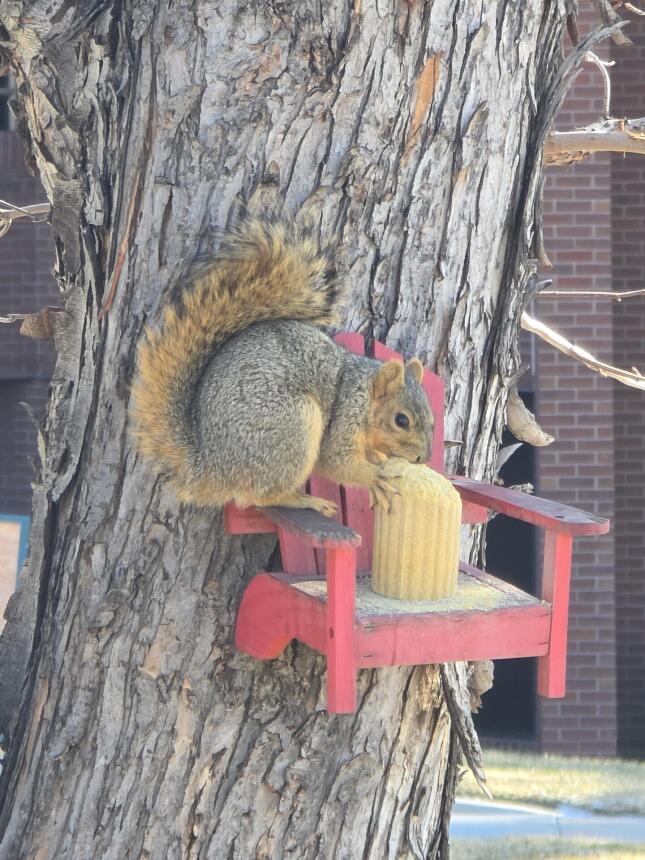
Despite his mischief, Wally is very much loved. He now has a brand new squirrel house and we make sure he is well stocked with snacks, just like our bird friends. His daily presence brings laughter, endless stories and photos, and a sense of connection to the wildlife that shares our space.
Meet the Fox Squirrel
Wally is a Fox Squirrel (Sciurus niger), one of North America’s tree squirrels.
Fox Squirrels are about 18–27 inches long (including tail), weigh about 2 pounds, and usually live about 3-4 years in the wild but some have been recorded to be as old as 12!
They are easily recognized by their full, bushy tails, sturdy bodies, and expressive faces. Coat color varies widely, even within the same region. Individuals may appear gray, rusty red, brown, blonde, or a mix of several colors. Their tails are often edged in white or pale silver, giving them a frosted look when backlit by the sun.
Their size and confidence set them apart from smaller squirrels. Fox squirrels tend to move more deliberately than agile species like the American Red Squirrel, often pausing to observe their surroundings or make eye contact before continuing on their way. That calm confidence is part of what makes them so entertaining to watch.
________________________________________
Fox squirrels are native to much of the eastern and central United States, with populations extending into parts of the Great Plains and Southwest. They thrive in a wide range of habitats, including: open woodlands, forest edges, urban parks and neighborhoods.
Unlike some squirrel species that prefer dense forests, fox squirrels do especially well in areas with open tree canopies and plenty of sunlight. Mature trees that produce nuts are essential, but they also need access to open ground where they can forage and bury food.
Urban and suburban environments have proven to be surprisingly suitable for fox squirrels. Bird feeders, backyard gardens, and ornamental trees provide reliable food sources, while buildings and large trees offer shelter. Wally’s comfort around our store is a perfect example of how adaptable this species can be.
________________________________________
Fox squirrels are omnivorous, but the bulk of their diet consists of plant material. Favorite foods include acorns, hickory nuts, walnuts, pecans, black oil sunflower seeds, corn, peanuts, tree buds and bark, and fruits and berries. Black oil sunflower seed happens to be Wally’s food of choice.
They will also occasionally eat insects, bird eggs, or fungi, especially when plant foods are scarce.
One of the most fascinating aspects of fox squirrel behavior is scatter hoarding. Instead of storing all their food in one place, they bury individual items across a wide area. This strategy helps ensure that if one cache is discovered by another animal, not all of their stored food is lost.
Fox squirrels use an impressive combination of memory, spatial awareness, and scent to relocate their buried treasures. Even months later, they can often return to the exact spot where a single nut was hidden. When they forget, those buried seeds may sprout, making fox squirrels accidental tree planters and important contributors to forest regeneration.
________________________________________
Fox squirrels typically have two breeding seasons each year, one in late winter and another in early summer. During breeding season, females attract multiple males, leading to energetic chases through trees and across open ground.
Courtship
Courtship involves persistent pursuit by males, vocalizations, and scent cues. Females ultimately choose their mate, often after several days of chasing and testing potential partners.
Nesting
After mating, the female builds a nest, called a drey, usually high in a tree. Dreys are constructed from leaves, twigs, moss, and other soft materials. Fox squirrels may also use tree cavities or even manmade structures if they provide adequate shelter.
Raising Young
A typical litter consists of 2–4 young. Babies are born blind, hairless, and completely dependent on their mother. Their eyes open at about five weeks of age, and they begin exploring outside the nest around seven to eight weeks.
Young fox squirrels are usually weaned by 10–12 weeks old and start foraging on their own shortly afterward. By the time they are four months old, they are largely independent, though they may remain in their mother’s territory for a short time before dispersing.
________________________________________
Tips for Attracting or Spotting Fox Squirrels
If you enjoy watching fox squirrels, there are several ways to make your yard more welcoming while still keeping things balanced for birds.
How to Attract Them
• Offer squirrel-friendly foods like corn, peanuts, squirrel logs, or sunflower seeds in a designated area
• Provide a squirrel feeder or feeding station away from bird feeders
• Maintain mature trees, especially nut-producing species
• Offer a squirrel house or nesting box for shelter
How to Spot Them
Fox squirrels are most active in the early morning and late afternoon. Look for them on the ground beneath trees, moving with purpose as they forage, or stretched out along large branches on warm days.
They are often more tolerant of people than other wildlife, making them easier to observe at close range.
________________________________________
Conservation Status and Concerns
Fox squirrels are currently considered stable across much of their range. Their adaptability has allowed them to thrive in human-altered landscapes.
They still face challenges, including loss of mature trees and open woodlands, vehicle collisions, increased predation by domestic pets, and secondary poisoning from rodenticides.
Providing natural food sources, avoiding poisons, and supporting habitat-friendly landscaping all help ensure that fox squirrels continue to be part of our shared environment.
________________________________________
This month, in honor of our 5 Nutty Years of store ownership, we celebrate Wally the Fox Squirrel as our honorary Bird of the Month and thank him for his entertainment and very thorough seed inspections.